GEOTECHNICALENGINEERING
KAMLOOPS
HomeGround improvementVibrocompaction design

Vibrocompaction Design in Kamloops: Ground Improvement for Variable Alluvial Soils

Practical geotechnics, field-tested.

LEARN MORE

Comparing a site in Sahali, perched on compact glacial till, to one in Valleyview, sitting atop looser fluvial sediments along the South Thompson River, highlights the stark contrasts we manage daily in Kamloops. The city’s semi-arid climate—averaging just 278 mm of precipitation annually—masks a complex subsurface shaped by glacial retreat and river migration. Designing vibrocompaction here means reading that history correctly. We apply energy-based densification logic rooted in field response, not generic charts, because the transition from dense till to liquefiable alluvium can happen within a single city block. This variability demands a ground improvement approach tailored precisely to local depositional sequences, and our triaxial testing program provides the critical strength parameters needed before any vibro treatment is finalized.

Achieving a 15% to 25% increase in relative density with vibrocompaction is routine in Kamloops sands, but only if the grain-size distribution confirms less than 12% fines.
Our service areas

How we work

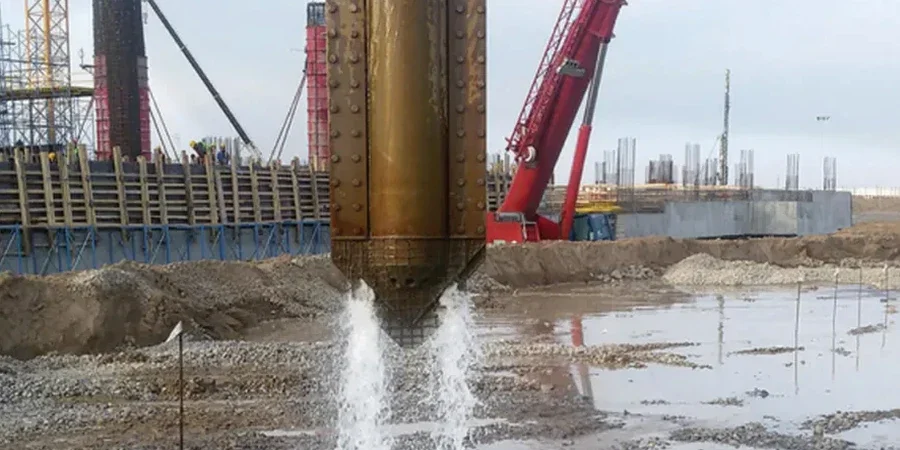
In Kamloops, we often see that the standard penetration test (SPT) N-values in the Valleyview and downtown flats can drop below 10 within the upper 5 meters, which immediately flags a loose condition under the National Building Code of Canada (NBCC 2020). A proper vibrocompaction design starts with quantifying the fines content because silty sands from overbank deposits behave differently than clean glaciofluvial sands. We use a depth vibrator with variable frequency and a design grid that typically ranges from 1.8 m to 3.5 m spacing, depending on the target relative density—usually 70% to 85% for structural support. The process is methodical: pre-treatment CPT soundings, a trial compaction zone with real-time energy monitoring, and post-treatment verification through cone penetration testing. While vibrocompaction is highly effective for clean sands, we often integrate it with other techniques when encountering the interbedded silt layers common near the Thompson River floodplain.
Vibrocompaction Design in Kamloops: Ground Improvement for Variable Alluvial Soils
Technical reference — Kamloops

Site-specific factors

The rapid expansion of Kamloops suburbs like Aberdeen and Pineview over the past two decades has pushed development onto terrains where loose glaciofluvial deposits were once left alone. The geotechnical risk is twofold: excessive differential settlement and potential seismically induced liquefaction in a region classified under NBCC Seismic Hazard Zone 4. A vibrocompaction design that skips rigorous pre-treatment characterization—specifically grain-size analysis and fines content determination—can leave untreated lenses that settle unpredictably under load. We have seen cases where a uniform grid design, applied without site-specific calibration, failed to densify silty pockets near old river channels, resulting in post-construction settlements exceeding 25 mm. The key is recognizing that Kamloops soil is not homogeneous; it is a patchwork of high-energy fluvial sands and lower-energy overbank silts, and the vibrocompaction plan must adapt to that reality.

Need a geotechnical assessment?

Reply within 24h.

Email: info@geotechnicalengineering.vip

Regulatory framework

NBCC 2020 (National Building Code of Canada) – Seismic and Geotechnical Provisions, CSA A23.3-14 – Design of Concrete Structures (foundation and ground improvement references), ASTM D4253/D4254 – Maximum and Minimum Index Density of Soils (vibrocompaction QC reference)

Technical parameters

ParameterTypical value
Applicable Soil TypesClean sands, silty sands (fines < 12–15%), gravelly sands
Effective Depth Range3 m to 35 m below grade
Typical Probe Spacing (triangular grid)1.8 m to 3.5 m center-to-center
Target Relative Density (Dr)70% to 85% for structural foundations
Post-Treatment VerificationCPT, SPT, or pressuremeter testing per CSA guidelines
Vibrator Power Range130 kW to 180 kW, with variable frequency up to 60 Hz
Average Compaction Radius1.5 m to 2.5 m, dependent on soil gradation and fines content

Frequently asked questions

How much does a vibrocompaction design study cost for a Kamloops site?

A complete vibrocompaction design package, including pre-treatment field testing, laboratory characterization, and the trial compaction report, typically ranges from CA$1,820 to CA$6,160 depending on site size, depth of treatment, and the number of verification CPT soundings required.

Does vibrocompaction work in silty soils near the Thompson River?

Vibrocompaction is most effective in sands with less than 12–15% fines. Near the Thompson River, many deposits contain interbedded silt layers where drainage is slower and densification less efficient. In those cases, we may recommend a hybrid approach using stone columns or compaction grouting to address the silty zones while vibrocompaction treats the sandier strata.

How do you verify that vibrocompaction has achieved the design density?

We use a combination of pre- and post-treatment CPT soundings at the same locations, comparing cone tip resistance and sleeve friction profiles. The increase in tip resistance directly correlates to the achieved relative density. For critical structures, we also run pressuremeter tests to confirm the deformation modulus of the treated ground.

What is the typical timeline for a vibrocompaction design and trial program in Kamloops?

A typical design cycle runs about four to six weeks: one week for field sampling and initial CPTs, two weeks for laboratory testing, one week for trial compaction and post-treatment CPT verification, and one to two weeks for analysis and reporting. Winter work is feasible but may require additional scheduling flexibility due to frozen ground conditions.

Location and service area

We serve projects in Kamloops and surrounding areas. More info.

View larger map