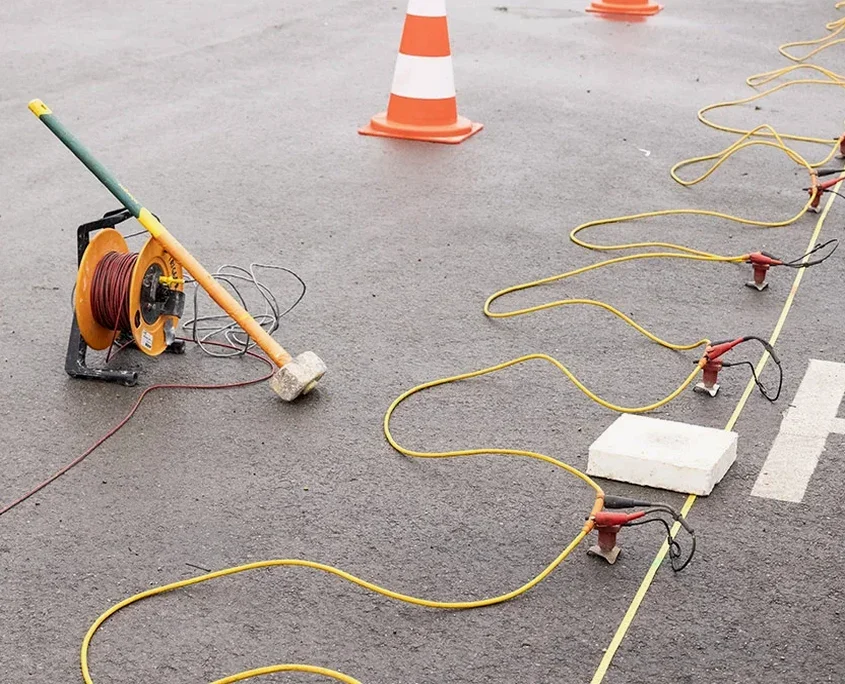
The geophone spread goes in first—usually 24 or 48 channels on a 3-meter spacing—and the trigger cable runs back to a 24-bit seismograph that’s been calibrated to factory specs the night before. In Kamloops we’re dealing with a dry, high-desert surface layer that kills signal fast, so the source has to be chosen carefully. A 10-kg sledge on an aluminum plate works for shallow targets under 15 m, but once the overburden thickens past the Thompson River terraces we switch to a Betsy seisgun or an accelerated weight drop that puts enough energy into the glacial till to return a clean first-break at 60 m plus. The crew sets up the line, hammers in the geophones, and takes a noise check before the sun hits the slope and traffic on the Trans-Canada starts masking arrivals. Calibration shots confirm trigger zero-time, and then the profile runs end-to-end in half an hour. Refraction processing picks first arrivals on every trace; the time-distance curves get inverted through a tomographic algorithm that produces a true 2-D velocity section, not a layered approximation. When the job demands deeper resolution—say a bedrock depression under a proposed foundation or a fault scarp hidden by colluvium—we run a reflection spread with a common-midpoint stack that images impedance contrasts down to 100 m. In the Valleyview benchlands a recent MASW survey confirmed a shear-wave velocity reversal at 12 m that the refraction alone had missed, so the combined approach became standard for any site where fill overlies native silt.
First-break picks on a 48-channel spread tell you more about Kamloops’s buried topography than a dozen boreholes drilled blind.