GEOTECHNICALENGINEERING
KAMLOOPS
HomeFoundationsRaft/mat foundation design

Raft/Mat Foundation Design in Kamloops: Ground-Adapted Solutions

Practical geotechnics, field-tested.

LEARN MORE

A crawler-mounted drill rig working the South Thompson river flats encounters something we know well in Kamloops: a sudden lens of soft, grey clay beneath a stiff crust. The operator adjusts the auger speed, and the sample coming up the hollow stem confirms what the landscape suggests. That sequence of advance, refusal, and retrieval drives the logic behind a raft foundation design here. We run SPT and Shelby tube samples on the same borehole because the city’s post-glacial stratigraphy — from the lacustrine silts of Aberdeen to the coarser fans near Batchelor Heights — demands a continuous strength profile. Data from CPT testing lets us map the depth to the competent till, which is rarely uniform across a single lot. In our experience, the decision to float a structure on a rigid mat rather than isolate footings comes down to that vertical variability, combined with the seismic hazard level defined by NBCC 2020 for the interior plateau.

In Kamloops, a mat foundation isn’t just a slab — it’s a settlement-compensating element that bridges the stiff crust and the soft clay beneath in one rigid plane.
Our service areas

How we work

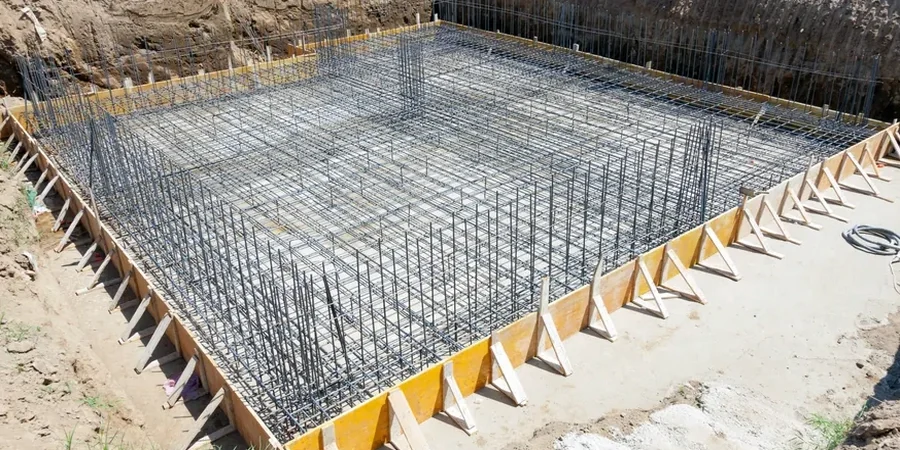
The contrast between a site in Westsyde and one in Sahali illustrates why Kamloops mat foundation design has to be site-specific. Westsyde terraces often sit on a thin veneer of granular fluvial deposits over compact till; bearing improves quickly with depth and settlement is modest. Sahali properties, particularly those cut into the lacustrine blanket, encounter a thicker sequence of compressible silt and clay that can lose strength when saturated during spring freshet. We bridge that difference with a test pit investigation to log the shallow fill and root zone, then follow with laboratory consolidation and triaxial shear tests on undisturbed samples. The stiffness of the mat distributes the structural load so that differential settlement between the cut and fill portions of a sloping lot stays within tolerable limits. For a single-family residence or a low-rise commercial block, the mat thickness we specify typically ranges from 300 to 600 mm, reinforced per CSA A23.3, with thickened edge beams where frost penetration reaches 1.2 m below grade.
Raft/Mat Foundation Design in Kamloops: Ground-Adapted Solutions
Technical reference — Kamloops

Site-specific factors

We often see owners in the North Shore area surprised by how much a mat foundation moves when the underlying lacustrine clay dries out during summer and re-saturates in October. The volume change isn’t obvious from surface cracks alone; it shows up in the elevation survey a year after construction. In Kamloops, the risk isn’t just total settlement — it’s differential heave at the perimeter where moisture fluctuates most. A mat that’s undersized or poorly drained concentrates curvature under load-bearing walls. We mitigate this by extending the granular drainage layer beyond the slab footprint and specifying a capillary break that stays effective even when irrigation raises the local water table. On sites near the Thompson River, where the liquefiable sand layer can sit just 4 m below the surface, we combine the mat with ground improvement by stone columns to improve drainage and densify the loose zone before concrete is placed.

Need a geotechnical assessment?

Reply within 24h.

Email: info@geotechnicalengineering.vip

Regulatory framework

NBCC 2020 — National Building Code of Canada, structural design and seismic provisions, CSA A23.3 — Design of Concrete Structures, ASTM D1194/D1195 — Plate Load Test procedures for subgrade modulus verification, CSA A23.1 — Concrete Materials and Methods of Concrete Construction, ASTM D2487 — Unified Soil Classification System (field logging reference)

Technical parameters

ParameterTypical value
Typical mat thickness (residential)300–600 mm
Reinforcement grade400W welded wire mesh or Grade 60 rebar per CSA A23.3
Minimum concrete strength (28-day)32 MPa, air-entrained for frost exposure
Frost depth design (Kamloops)1.2 m below finished grade
Allowable total settlement25 mm (residential) / 50 mm (commercial) per NBCC
Seismic design categorySite Class D or E per NBCC 2020, depending on shear wave velocity
Subgrade preparationCompacted granular base, minimum 150 mm, proof-rolled before pour

Frequently asked questions

What does a raft/mat foundation design cost for a standard residential lot in Kamloops?

For a typical single-family lot in Kamloops, the combined geotechnical investigation and structural mat design generally runs between CA$1,220 and CA$5,330. The final figure depends on the number of boreholes required, the depth to competent ground, and whether we need to run consolidation or triaxial tests on the silty clays common in areas like Aberdeen or Sahali.

How do the glacial lakebed clays in Kamloops affect mat foundation performance?

These clays are preconsolidated near the surface but become normally consolidated at depth, meaning they can settle significantly under load. A rigid mat bridges the stiffer crust and spreads the structural weight, reducing differential movement. We always run an oedometer test to measure the compression index before finalizing mat thickness.

Is a raft foundation a good choice for sloping lots in the Batchelor Heights area?

Yes, provided the cut-and-fill geometry is well understood. On slopes with more than 2 m of fill over native till, we often recommend a mat with deepened edge beams on the downhill side and a granular key to lock the fill bench. This approach controls both settlement and lateral spread during the seismic event that NBCC 2020 anticipates for the Kamloops region.

What concrete mix specification do you recommend for a Kamloops mat foundation?

We specify a minimum 32 MPa, air-entrained mix with a maximum water-cement ratio of 0.45 for exterior exposure. In Kamloops, where winter temperatures can dip below -20°C, the air void system is essential for freeze-thaw durability. The mix design must comply with CSA A23.1 exposure class C-2, and we verify air content and slump on site before the pour.

Location and service area

We serve projects in Kamloops and surrounding areas.

View larger map