GEOTECHNICALENGINEERING
KAMLOOPS
HomeLaboratoryGrain size analysis (sieve + hydrometer)

Grain Size Analysis (Sieve + Hydrometer) in Kamloops

Practical geotechnics, field-tested.

LEARN MORE

We recently ran a full particle-size distribution on a silty sand from a foundation excavation near the Thompson Rivers University campus. The contractor was surprised by the fines content once the hydrometer data came in. Kamloops geology throws curveballs like that. Glaciofluvial deposits can look clean at first glance, but the silts from the glacial lake sediments that underlie much of the valley floor change the engineering behavior entirely. Grain size analysis is not just a classification exercise; it dictates permeability, frost susceptibility, and compaction specs. Our lab runs the complete curve, from coarse gravel retained on the 75 mm sieve down to the clay fraction below 2 microns, using ASTM D6913 and D7928 procedures. For projects along the Thompson River or up in the Aberdeen hills, getting the full gradation right determines whether your fill will drain or trap water during the spring thaw. A test pit investigation paired with our grain size analysis gives you the ground truth before you start moving material.

A single hydrometer test reveals more about a silt's behavior than a hundred sieve pans on the coarse fraction.
Our service areas

How we work

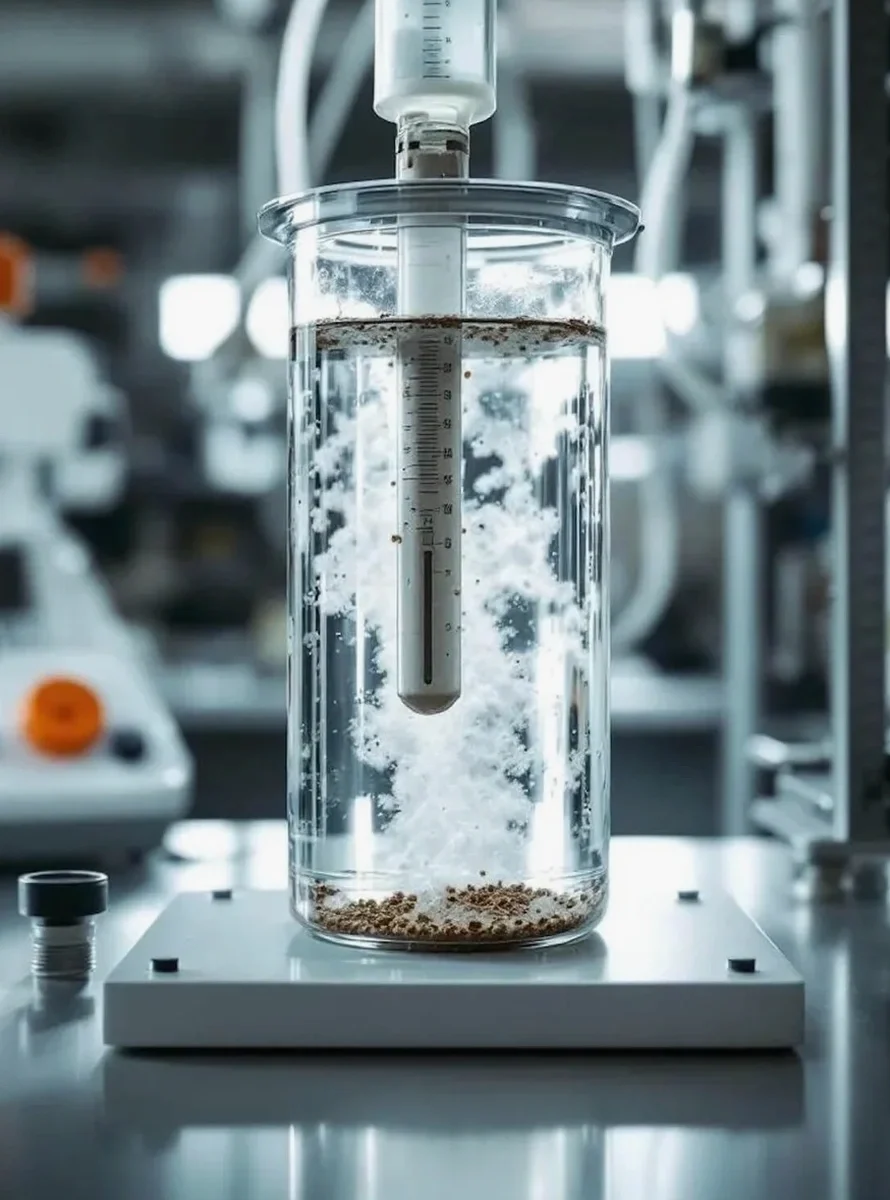
The Thompson Valley is a complex mix of glaciolacustrine silts, till, and fluvial sands. That means uniform classification based on a single sieve stack is risky. We wash every sample through the No. 200 sieve first, then dry-sieve the coarse fraction and run the hydrometer on the fines. The hydrometer test takes at least 24 hours, sometimes longer if the silt content is high. We read densities at 2, 5, 15, 30, 60, 250, and 1440 minutes, correcting for temperature and dispersing agent. D10, D30, and D60 come directly from the combined curve. From those we calculate Cu and Cc. For the sandy gravels common in the Brocklehurst area or the silty sands downtown, these coefficients tell you immediately if the material is well-graded or gap-graded. When we encounter high fines content, we often recommend checking the Atterberg limits to confirm the plasticity of the fine fraction, which influences the soil's response to moisture changes during Kamloops' dry summers and wet shoulder seasons.
Grain Size Analysis (Sieve + Hydrometer) in Kamloops
Technical reference — Kamloops

Site-specific factors

Skipping the hydrometer on a silty sand in Kamloops is a gamble. We have seen projects on the North Shore where a visual classification called it 'clean sand,' but the lab showed 18% fines. That misclassification changes the seismic site class under NBCC 2020. It alters the liquefaction assessment. We run the hydrometer with sodium hexametaphosphate as the dispersing agent, and we shake the cylinder for exactly one minute before starting the clock. Temperature control is tight; our lab keeps the bath at 20°C. If your grain size curve is based solely on sieve data, you do not have the full picture. The fine fraction controls capillary rise, frost heave potential, and drainage. In a city where winter temperatures drop below -20°C and the frost depth reaches 1.2 meters, that matters.

Need a geotechnical assessment?

Reply within 24h.

Email: info@geotechnicalengineering.vip

Regulatory framework

ASTM D6913 (Sieve Analysis), ASTM D7928 (Hydrometer Analysis), NBCC 2020 (Seismic Site Classification), CSA A23.3 (Concrete Aggregates)

Technical parameters

ParameterTypical value
Test Standard (Coarse)ASTM D6913
Test Standard (Fine)ASTM D7928
Sieve Range75 mm to 0.075 mm (No. 200)
Hydrometer Range0.075 mm to < 0.001 mm
Sample Mass Required500 g (sand) to 200 g (silt/clay)
Reported CoefficientsD10, D30, D60, Cu, Cc
Fines ContentPercent passing 0.075 mm sieve

Frequently asked questions

Why do I need the hydrometer if I already have the sieve results?

The sieve stack stops at 0.075 mm. Everything finer passes through and you lose the gradation of the silt and clay fraction. The hydrometer extends the curve down to 0.001 mm. Without that data, you cannot classify the soil correctly under the Unified Soil Classification System, and you miss critical parameters like the clay fraction that affect cohesion, permeability, and frost susceptibility.

How much sample do you need for a full grain size analysis?

For a combined sieve and hydrometer, we need about 500 grams of material passing the 4.75 mm sieve. If the soil is predominantly fine-grained, 200 grams is sufficient. The sample must be oven-dried and representative. We can split larger samples in the lab using a riffle splitter.

What is the cost of a grain size analysis in Kamloops?

A combined sieve and hydrometer analysis typically ranges from CA$160 to CA$280, depending on whether we are testing a single sample or a batch, and on the complexity of the soil matrix. Soils with high organic content or unusual mineralogy may require additional preparation steps.

How long does the test take from sample drop-off to report?

The hydrometer alone requires a minimum 24-hour sedimentation period. After that, we process the data, combine the curves, and run quality control checks. Standard turnaround is 3 to 4 business days. Rush service is available for an expedited schedule.

Location and service area

We serve projects in Kamloops and surrounding areas.

View larger map