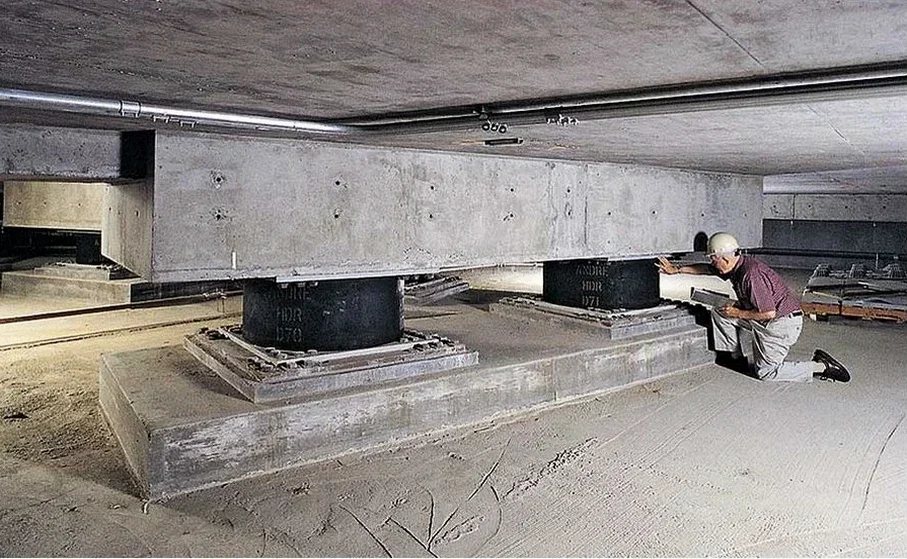
Kamloops sits at the confluence of two rivers, but its seismic story is shaped by what lies beneath: thick Quaternary deposits over 300 meters deep in the valley center. The city’s growth from a fur trading post into a regional health and education hub has placed major infrastructure on soils that amplify long-period ground motion. Base isolation seismic design addresses this directly. By inserting flexible bearings between the foundation and superstructure, the system shifts the building’s natural period away from the dominant earthquake energy—critical when the site period, driven by deep lacustrine silts and glacial till, aligns with the 0.5 to 1.5 second range that damages mid-rise structures. The design process integrates site-specific hazard from the National Building Code of Canada with nonlinear time-history modeling to confirm that isolators perform within their tested limits. For facilities like Royal Inland Hospital, where post-event operability is non-negotiable, seismic microzonation provides the subsurface velocity profile needed to calibrate isolator properties, and the CPT test logs shear wave velocity through the full soil column without disturbing sensitive silts.
In Kamloops, base isolation is not about eliminating seismic force—it is about controlling where the energy goes when valley soils amplify motion at exactly the wrong frequency.